Echinacea: A UK Guide to Species, Forms, Safety & How to Choose
Echinacea is one of the most popular herbal supplements in the UK, especially through the colder months. But there is a lot of confusion about what it actually is, which type to buy, and what the evidence really says. This guide is a clear, honest walk-through: the different species, the forms you can buy, the safety points that genuinely matter, and how to choose a quality product.
What is echinacea?
Echinacea — commonly called coneflower — is a group of flowering plants native to North America, where they were used traditionally by Indigenous peoples long before they became a mainstay of European herbalism. The plants belong to the daisy family (Asteraceae), which matters for allergy reasons we'll come to. Supplements are made from the flowering tops, leaves and/or roots, depending on the species and the manufacturer.
The three species you'll see
Not all echinacea is the same plant. Three species dominate the supplement market, and they differ in which part is used and their traditional preparations:
Echinacea purpurea
The most widely used and best-studied species. Preparations are made from the aerial (above-ground) parts and sometimes the root. This is the type most commonly found in UK products.
Echinacea angustifolia
Traditionally the root is used. It was historically the most prized by early herbalists and has a distinctive tingling sensation on the tongue from compounds called alkylamides.
Echinacea pallida
Also a root-based preparation, less common in mass-market products but used in some traditional formulas. Easily confused with angustifolia in older literature.
Why this matters: because the species and plant part differ, one echinacea product can be quite unlike another. When comparing products, the species and the part used are more informative than the milligram number on the front of the pack.
The forms echinacea comes in
- Capsules and tablets — convenient, consistent dosing; often standardised and easy to combine with added nutrients such as vitamin C, vitamin D and zinc.
- Tinctures and liquid extracts — alcohol or glycerine extracts, valued in traditional herbalism; the alkylamide "tingle" is often noticeable.
- Teas and dried herb — the most traditional form, milder and pleasant, though the amount of active compounds varies.
- Pressed juice preparations — made from fresh E. purpurea aerial parts, used in several well-known European products.
What does the research actually say?
This is where honesty matters. Echinacea and the common cold has been studied a great deal, and the picture is genuinely mixed. The most authoritative summary is a Cochrane systematic review (Karsch-Völk and colleagues, 2014), which pooled the trials and concluded that the evidence is not convincing — individual products showed weak signals, but results were inconsistent and no strong, reliable benefit was established. The reviewers noted that the many different species, plant parts and preparations make it hard to draw firm conclusions.
In plain terms: echinacea has a long traditional reputation and is enormously popular, but the clinical evidence does not let anyone — us included — promise it will prevent or shorten a cold. Anyone who tells you otherwise is overselling. We'd rather you buy it (or not) with clear eyes.
The vitamin difference in an immune formula
Many modern echinacea products — including ours — are built as a broader immune formula with added vitamins and minerals. This matters because, unlike the herb, several of those nutrients do carry authorised UK/EU health claims when a serving provides a meaningful amount (at least 15% of the Nutrient Reference Value):
- Vitamin C contributes to the normal function of the immune system.
- Vitamin D contributes to the normal function of the immune system.
- Zinc contributes to the normal function of the immune system.
These claims belong to the nutrients, not to echinacea — but they are real, label-checkable, and a good reason to read the Supplement Facts panel rather than the marketing on the front.
Safety: the points that genuinely matter
- Autoimmune conditions: echinacea acts on the immune system, so if you have an autoimmune condition (or take immune-suppressing medication) speak to your doctor before using it.
- Duration: traditional guidance and regulators generally suggest not taking it continuously for long stretches — typically not beyond around 10 days at a time for acute use, or with breaks. Follow your product's label.
- Pregnancy & breastfeeding: there isn't enough safety data, so it's best avoided unless a healthcare professional advises otherwise.
- Children: use only age-appropriate products and follow the label; some products are not suitable for young children.
- Medication & conditions: if you take any medicine or manage a health condition, check with your GP or pharmacist first.
How to choose a quality echinacea supplement
- Know the species and part. A good product tells you which species (e.g. E. purpurea) and which part (aerial/root) is used.
- Check the real strength per serving — and whether it's a standardised extract or dried herb.
- Look for third-party testing for purity and contaminants, with a Certificate of Analysis available on request.
- Sensible added nutrients. Added vitamin C, vitamin D or zinc bring their own authorised immune claims when present at meaningful levels.
- GMP manufacture and full ingredient + allergen labelling.
- An honest seller — clear contact details, and no dramatic "cures colds" claims. If a product promises to stop you getting ill, that's a red flag.
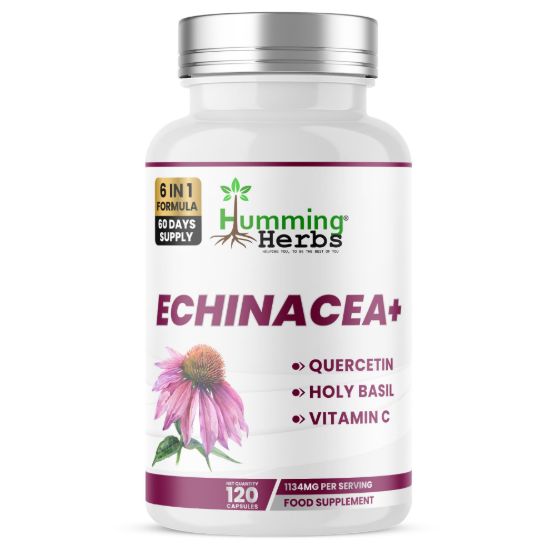
Humming Herbs Echinacea 6-in-1 Formula
Our echinacea is combined into a broader immune formula that includes added vitamin C, vitamin D and zinc — each of which contributes to the normal function of the immune system. It's third-party tested, and you can check the full Supplement Facts, including the echinacea species and the exact nutrient amounts, on the product page.
Frequently asked questions
Does echinacea prevent or cure colds?
We can't tell you that. As a food supplement it isn't a medicine, and the clinical evidence (summarised by Cochrane) is inconclusive. It has a long traditional reputation, but no reliable proof of preventing or curing colds.
Which echinacea species is best?
E. purpurea is the most widely used and best-studied. The "best" one really depends on the preparation — which is why the species and plant part on the label matter.
How long can I take echinacea?
Follow your product's label. General guidance is to avoid continuous long-term use — often it's used short-term with breaks rather than every day indefinitely.
Who should avoid echinacea?
Anyone allergic to the daisy family; people with autoimmune conditions or on immune-suppressing medicines (without medical advice); and, to be safe, those who are pregnant or breastfeeding. Check with a pharmacist if you're unsure.
Is echinacea the same as a THR herbal medicine?
Not necessarily. Some echinacea products are registered under the Traditional Herbal Registration scheme, which is a separate medicines route. A food supplement is a different category and makes no medicinal claims.
References & further reading
- Karsch-Völk M, Barrett B, Kiefer D, Bauer R, Ardjomand-Woelkart K, Linde K. Echinacea for preventing and treating the common cold. Cochrane Database of Systematic Reviews 2014, Issue 2. CD000530.pub3.
- European Medicines Agency, Committee on Herbal Medicinal Products (HMPC) — monographs on Echinacea purpurea herb and root.
- US National Center for Complementary and Integrative Health (NCCIH) — Echinacea: What You Need To Know.
- GB Nutrition and Health Claims Register — authorised claims for vitamin C, vitamin D and zinc (immune function).
Comments (0)