What Does the Research Say About Echinacea? An Honest Look
Echinacea is one of those supplements almost everyone has heard of — and one where the marketing and the science don't always line up. So let's do something a little unusual for a supplement company: look honestly at what the research actually shows, including the parts that aren't flattering. If you're deciding whether echinacea is worth your money, you deserve the real picture.
The headline: the evidence is inconclusive
The single most authoritative summary of echinacea and the common cold is a Cochrane systematic review (Karsch-Völk and colleagues, 2014), which pulled together the randomised controlled trials on the subject. Its conclusion, in short: the evidence does not convincingly show that echinacea prevents or meaningfully shortens colds. A few individual products showed small, weak signals, but across the body of trials the results were inconsistent and didn't add up to reliable proof.
Cochrane reviews are widely regarded as the gold standard of evidence synthesis precisely because they don't cherry-pick — they weigh the good trials and the disappointing ones together. When they say "not convincing," that's worth taking seriously.
Why is the research so messy?
Part of the problem is that "echinacea" isn't one thing. Trials have used wildly different preparations, which makes them hard to compare:
Different species. E. purpurea, E. angustifolia and E. pallida have different chemistry — yet all get called "echinacea."
Different plant parts. Root, aerial parts, or a mix — each yields a different extract.
Different preparations & doses. Pressed juice, alcohol tincture, dried powder, standardised extract — at doses that vary from study to study.
Pool all of that together and it's no surprise the results don't give a clean answer. It also means a positive result for one specific product doesn't automatically transfer to a different one on the shelf.
Traditional use vs clinical proof
Echinacea has a genuinely long history of traditional use, and that history is why some products qualify for a Traditional Herbal Registration (THR) in the UK. But it's important to understand what THR actually means: it is based on traditional use over a long period, not on modern clinical proof of effectiveness. The European Medicines Agency's herbal committee (HMPC) has assessed echinacea on that traditional-use basis. So "it's been used for generations" is true — and is a different statement from "trials prove it works."
The US National Center for Complementary and Integrative Health (NCCIH) reaches a similar bottom line: findings are mixed, and echinacea hasn't been shown to reliably prevent colds. Again — not our marketing spin; that's the public-health body's own summary.
Is it safe?
For most healthy adults, short-term use of echinacea is generally well tolerated. The most important safety point is allergy: echinacea is in the daisy (Asteraceae) family, so anyone allergic to daisies, ragweed, marigolds or chrysanthemums should avoid it, and rare severe allergic reactions have been reported. People with autoimmune conditions, those on immune-affecting medication, and those who are pregnant or breastfeeding should get medical advice first. It's generally used short-term rather than continuously.
So should you bother?
That's genuinely your call, and it's a reasonable one to make either way. Some people value echinacea for its traditional place in herbal routines and find it a pleasant part of their winter regimen. Others will look at the Cochrane verdict and decide it's not for them. Both are sensible positions — and we'd rather you choose based on the real evidence than a marketing promise.
If you do choose echinacea
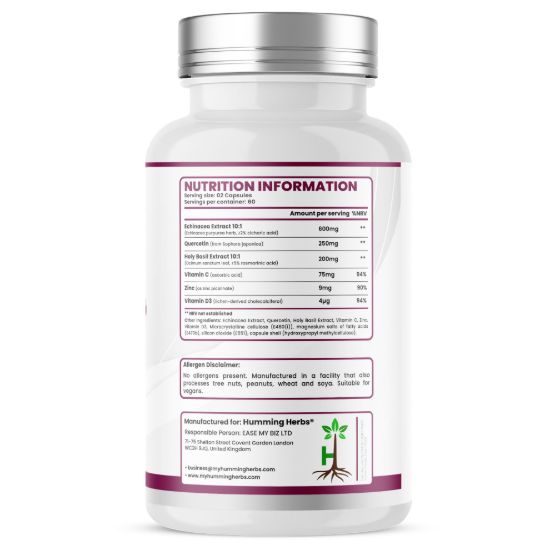
Our Echinacea 6-in-1 Formula pairs echinacea with added vitamin C, vitamin D and zinc — nutrients that each contribute to the normal function of the immune system, and which (unlike the herb) carry authorised UK health claims when present at meaningful levels. It's third-party tested, with the full Supplement Facts shown on the product page so you can see exactly what you're getting.
References & further reading
- Karsch-Völk M, Barrett B, Kiefer D, Bauer R, Ardjomand-Woelkart K, Linde K. Echinacea for preventing and treating the common cold. Cochrane Database of Systematic Reviews 2014, Issue 2. CD000530.pub3.
- European Medicines Agency, Committee on Herbal Medicinal Products (HMPC) — assessment reports and monographs on Echinacea purpurea.
- US National Center for Complementary and Integrative Health (NCCIH) — Echinacea: What You Need To Know.
- GB Nutrition and Health Claims Register — authorised immune-function claims for vitamin C, vitamin D and zinc.
Comments (0)